How ChatGPT search chooses its sources (and where Bing fits)
Affiliate link: Geocitely may earn a commission if you sign up. It never affects our rankings. Rankscale links in this article are affiliate links.
In this article (10 sections)
In a High Salience study of 200 ChatGPT answers collected on 21 October 2026, 79% of the pages ChatGPT cited (175 of 221) were on neither Google's nor Bing's first page for the exact searches ChatGPT ran. Ahrefs saw the same pattern in 2025, with only about 8% of citations in either engine's top 10. So ranking well in a search engine is not what gets you cited.
Short answer: when ChatGPT searches the web, it turns your question into one or more short search queries, sends them to search partners (Microsoft is one OpenAI names), reads what comes back and cites the pages it judges relevant and reliable. OpenAI hasn't published the ranking formula. Independent studies show the cited pages overlap only partly with Bing's or Google's top results, so ranking in a search engine helps but doesn't decide the answer.
This post goes deeper on the mechanics behind our main guide, how to get your brand recommended by ChatGPT. Facts about how ChatGPT works come from OpenAI's help center, developer docs and announcements, checked on 28 October 2026. Where a number comes from third-party research, we name who measured it and when.
First: does ChatGPT search at all?
Not always. ChatGPT can answer from what the model learned in training, or it can search the web first. OpenAI's help center says ChatGPT "may search the web automatically when your question would benefit from current information", and anyone can switch search on by hand from the tools menu (or by typing / in the message box). Web search is available on every plan, Free included, and to people who aren't signed in.
This matters for you because only the search path has sources you can influence this month. A buying question such as "best invoicing app for freelancers in 2026" usually triggers a search. A general question such as "what is double-entry bookkeeping?" often doesn't, and then the answer comes from training data with no live sources at all.
Step 1: Your question becomes search queries
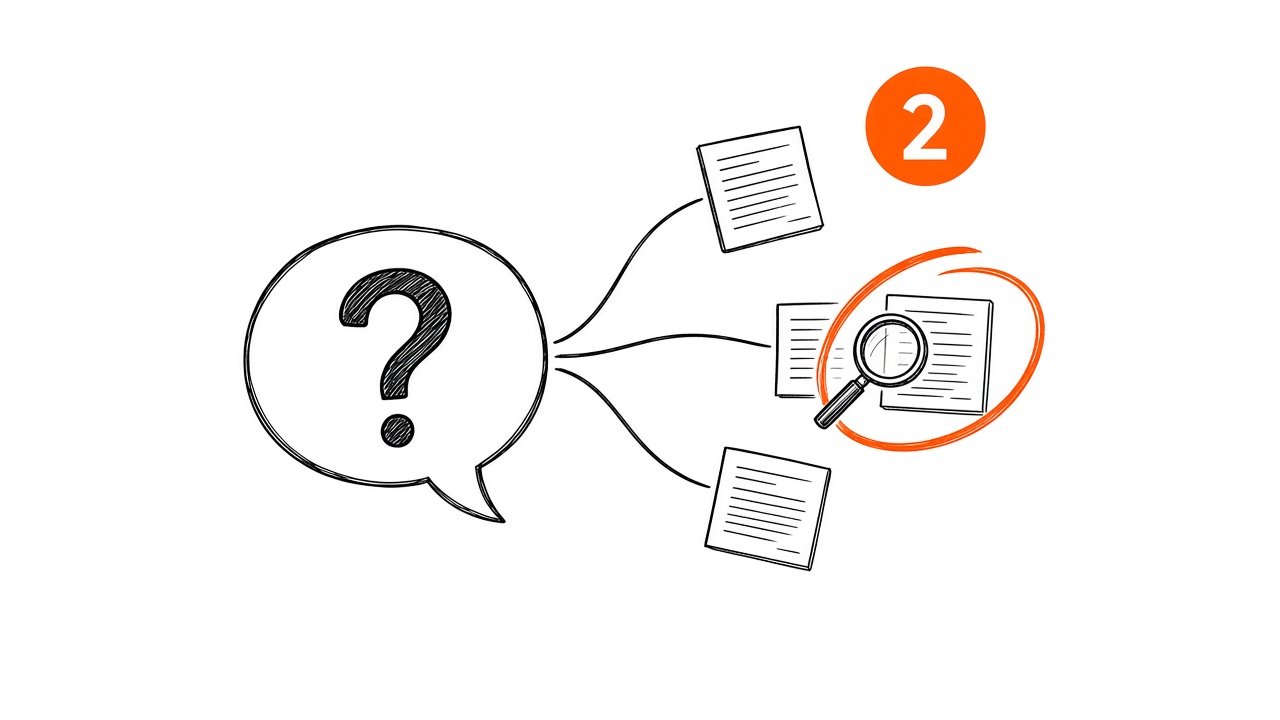
ChatGPT doesn't send your exact words to a search engine. OpenAI explains that ChatGPT search "typically rewrites your query into one or more targeted queries" and, after reviewing the first results, "may send additional, more specific queries". Its own example: a question about drugs that target CCR8 becomes the search "CCR8 immunotherapy drug development 2025", followed by a narrower search for a specific drug name.
The rewrite also uses context:
- Location. ChatGPT estimates your general location from your IP address. OpenAI's example turns "What are some good restaurants near me?" into "top restaurants San Francisco".
- Memory. If memory is on, saved details can change the query. A user who said they are vegan gets "good vegan restaurants San Francisco".
- The whole chat. Follow-up questions are read in the context of what came before.
These rewritten searches are often called fan-out queries. How many are there? Ahrefs looked at 118,931 of them from its Brand Radar data (published 20 August 2025) and found ChatGPT ran 1.78 searches per prompt on average, with 75% of prompts triggering exactly two.
Newer data shows the number now depends on the model. An October 2026 arXiv study traced ChatGPT's own server events between March and July 2026: GPT-5.3 Instant ran 1.06 searches per answer on average, GPT-5.5 Instant 1.45, and GPT-5.4 Thinking 11.82 over about three rounds. In none of the GPT-5.3 or GPT-5.5 Instant runs did ChatGPT search the user's exact words.
The practical point: you are competing for the rewritten searches, not for the long chatty question the buyer typed. Seer Interactive saw this in early 2025: longer questions were simplified into classic search phrases. The rewrites have since grown more specific. In High Salience's October 2026 sample, ChatGPT's searches averaged 11 words and stacked the year, brand names and comparison terms, such as "best travel rewards credit cards 2026 annual fee welcome bonus benefits comparison".
Step 2: The queries go to search partners
Where do the results come from? OpenAI says ChatGPT search "sometimes partners with other search providers", and in that section its help center points readers to the privacy policies of two of them: Microsoft and Shopify. OpenAI's launch post for ChatGPT search (31 October 2024) adds that it "leverages third-party search providers, as well as content provided directly by our partners", such as news and data providers for weather, stocks, sports and maps.
OpenAI also runs its own crawler for search. Its developer docs say OAI-SearchBot "is used to surface websites in search results in ChatGPT's search features", and that sites which block it "will not be shown in ChatGPT search answers, though can still appear as navigational links". A separate agent, ChatGPT-User, visits a page when a user's request needs it, and OpenAI states it "is not used to determine whether content may appear in Search".
So there isn't one index behind ChatGPT. There are partner search results, partner data feeds and OpenAI's own crawl, and OpenAI hasn't published the exact mix.
The best outside look so far comes from Peec AI (September 2026). Between 21 May and 21 July 2026, a field in ChatGPT's server events named the source of each result. It carried four values: Labrador, which Peec describes as OpenAI's own family of indexes (general web, news, PDF, YouTube, Wikipedia, shopping and more), plus Bright, Oxylabs and SERP, which Peec identifies as providers of scraped Google results. Peec also lists Yelp, TripAdvisor and Microsoft's Web IQ, which Microsoft says powers ChatGPT. This is third-party analysis, not an OpenAI statement.
Does ChatGPT use Bing?
Yes, as one source, but probably not the only one. Here is what is on the record:
- May 2023: Microsoft announced that Bing was "coming to ChatGPT as the default search experience" (Bing blog and Microsoft Build news, 23 May 2023).
- 2026: Peec AI reports Microsoft's Web IQ grounding service among ChatGPT's providers and Bing showing up mainly in Deep Research, next to OpenAI's own index and scraped Google results.
- Today: OpenAI's help center names Microsoft among the search providers whose privacy policy applies to ChatGPT search queries. It doesn't say what share of searches Microsoft handles.
What did independent tests find? The results moved over time, which is itself useful to know:
| Study | When | What it found |
|---|---|---|
| Seer Interactive | Feb 2025, about 100 questions, 500+ citations | 87% of ChatGPT search citations were in Bing's top 20 for the same question, against 56% for Google |
| Profound | Aug 2025, sample of 240M citations | ChatGPT's match with Bing results fell from 26% (April 2025) to 8% (July 2025), while its match with Google rose from 12% to 33% |
| Ahrefs | Aug 2025, 15,000 prompts | 8.1% of ChatGPT's citations were in Bing's top 10 and 8.0% in Google's top 10 for the same prompt |
| Ahrefs | Aug 2025, 118,931 fan-out queries | Only 6.82% of ChatGPT's search results were in Google's top 10 for the same query, and 16.61% were anywhere in Google's results |
| Jiang et al. (arXiv) | Data Mar to Jul 2026, 80 questions, 20 runs each | Google results plus the OpenAI API together found only 26% to 28% of the URLs ChatGPT cited, but about half of the cited sites (hostnames) |
| High Salience | 21 Oct 2026, 200 answers | 79% of cited pages were on neither Google's nor Bing's first page for ChatGPT's own searches; across 198 answers, 17% of cited pages were on Bing's first page |
The studies used different methods, so the numbers don't line up neatly. The direction is consistent, though: Bing mattered a lot in early 2025, the overlap with any single search engine has since dropped, and in 2026 most cited pages still don't match either engine's first page. Ahrefs' own reading is that ChatGPT likely combines results from several sources and then re-ranks them itself. The 2026 Peec AI findings on OpenAI's own index fit that reading, though OpenAI still hasn't confirmed it.
Does ChatGPT use Google?
OpenAI doesn't list Google as a search partner in its help center. Some SEOs have reported results that look like Google's, and Profound's data shows a rising match with Google during 2025. Ahrefs' fan-out study argues against ChatGPT simply pulling Google's results, since 83% of the URLs ChatGPT got back didn't appear in Google at all for the same query. Newer evidence points to Google results being used indirectly. Peec AI (September 2026) saw result sources it identifies as scraped Google results in ChatGPT's server events, and a test site with no organic traffic got Google Search Console impressions on the days it was queried only in ChatGPT. The honest answer is: OpenAI hasn't confirmed it, and 2026 data suggests Google results are one input among several, not the answer key.
Step 3: ChatGPT picks which pages to cite
After the results come back, the model reads them and writes the answer. On how it chooses, OpenAI says only that ChatGPT "ranks search results using multiple factors intended to help users find relevant, reliable information" and that "placement is not guaranteed". There is no published list of factors.
What the studies observed about the pages that do get cited:
- For "best" and "top" questions, lists win. Seer found that affiliate sites, news sites and aggregators were the most-cited types, partly because most of its test questions used "best" or "top".
- Position counts less than in classic search. In the cases where ChatGPT's citations matched Google's top 10, Profound found citations spread much more evenly across positions 1 to 10 than human clicks do. Page 1 position 8 still has a real chance.
- Page 2 isn't dead. Seer saw many Bing matches in positions 11 to 20.
- Showing up repeatedly helps. In the 2026 arXiv study, pages ChatGPT retrieved more often across repeated runs were more likely to be cited, and cited pages tended to have longer, self-contained snippets.
- Established sites still win the citation. High Salience (October 2026) found small sites made up 26% of the pages ChatGPT pulled up but only 14% of the pages it cited, close to Google's page one (13%).
What this means for getting your pages cited
Put together, the chain is: question, rewritten queries, partner results plus OpenAI's crawl, then the model's own choice. You can't touch the last step directly, but you can improve your odds at every step before it.
| Step | What you can do |
|---|---|
| Crawl access | Allow OAI-SearchBot in robots.txt and ask your host or CDN to allow OpenAI's published IP ranges (openai.com/searchbot.json). OpenAI says robots.txt changes take about 24 hours to apply to search |
| Search indexes | Make sure your key pages are indexed in Bing (Bing Webmaster Tools shows this) and Google. Submitting new URLs through IndexNow gets them to Bing quickly |
| Rewritten queries | Give each buying question a page whose title and opening plainly match the short search behind it: category, audience, use case, year |
| Re-ranking | Get named on the third-party pages that already rank for those searches: comparison lists, review sites, community threads |
| Measurement | Track which queries ChatGPT runs and which domains it cites for your category, every few weeks |
Blocking GPTBot is a separate choice. OpenAI's docs say the two settings are independent: you can disallow GPTBot (training) and still allow OAI-SearchBot (search).
How to see which sources ChatGPT uses in your category
You can do this by hand in an hour:
- Write down 10 to 20 questions your buyers ask, in their words.
- Ask each one in ChatGPT with search switched on, in a fresh chat.
- Open Sources under each answer and list every domain it cites.
- Count how often each domain comes up. The top of that list is where your effort should go.
Our step-by-step guide on checking whether ChatGPT, Perplexity and AI Overviews mention your brand shows a simple sheet layout for recording it, and our explainer on mentions, citations and recommendations covers why a cited source and a recommended brand are two different results.
If you want the fan-out queries themselves, some trackers show them. Otterly.AI has a query fan-out tool and citation source tracking. Rankscale shows query fan-out next to citations; Essentials is listed at $20 a month or $204 a year on its pricing page (checked 28 October 2026). LLMrefs builds fan-out prompts per keyword and lists every source URL each engine cites. For a free start, geoSurge has a $0 desktop app that runs your prompts on the ChatGPT, Claude or Gemini plan you already pay for and shows the sources (checked on geosurge.ai/pricing, 28 October 2026). Compare all 32 tools we list on the pricing table or browse the free AI visibility tools.
FAQs
Does ChatGPT always search the web before answering?
No. OpenAI says ChatGPT "may search the web automatically when your question would benefit from current information". Buying questions usually trigger a search; general knowledge questions often don't.
Does ChatGPT use Bing or Google?
OpenAI names Microsoft among its search providers and doesn't list Google. Independent studies from 2025 and 2026 found the overlap with both engines' first page is small, and 2026 research shows ChatGPT also uses its own index and scraped Google results, so neither engine decides the answer on its own.
Can I block GPTBot and still appear in ChatGPT search?
Yes. OpenAI's docs say the settings are independent: you can disallow GPTBot (training) and still allow OAI-SearchBot (search).
How do I see which sources ChatGPT cites for my category?
Ask 10 to 20 buyer questions with search on in fresh chats, open Sources under each answer and count the domains. Trackers such as Otterly.AI, Rankscale and LLMrefs show fan-out queries and cited URLs.
Our recommendation
- Rule out the silent failure first. Check robots.txt and your CDN for OAI-SearchBot. It's the only requirement OpenAI spells out.
- Treat Bing as insurance. Being indexed there is cheap, and Microsoft is a named partner. Don't assume a Bing top-3 ranking means a ChatGPT citation; the 2025 and 2026 studies say it often doesn't.
- Write for the rewritten query. Short, plain titles and openings that match "best [category] for [audience]" searches.
- Spend most of your time on the pages ChatGPT already cites for your category, and earn an honest place on them.
- Measure the same questions on a schedule. The source mix changed a lot during 2025 and again with each 2026 model update, and it will keep changing.
For the full set of steps, from site access to local listings and product feeds, go back to the main guide: how to get your brand recommended by ChatGPT. You can also start with our free AI visibility snapshot to see where you stand today.
Sources
- High Salience: Where does ChatGPT get its information? 200 answers checked (21 Oct 2026)
- Jiang et al. (arXiv): Understanding ChatGPT citations across model generations (11 Oct 2026)
- Peec AI: ChatGPT built its own search index (4 Sep 2026)
- OpenAI Help Center: Searching the web with ChatGPT (live doc; checked 28 Oct 2026)
- OpenAI: Overview of OpenAI crawlers (live doc; checked 28 Oct 2026)
- Ahrefs: Is ChatGPT really powered by Google? 118931 fan-out queries analyzed (20 Aug 2025)
- Ahrefs: Only 12% of AI cited URLs rank in Google's top 10 (11 Aug 2025)
- Profound: ChatGPT's growing alignment with Google's index (Aug 2025)
- Seer Interactive: 87% of SearchGPT citations match Bing's top results (6 Feb 2025)
- Background: OpenAI launch post Introducing ChatGPT search (31 Oct 2024)
- Background: Bing at Microsoft Build 2023 (23 May 2023)
All prices were checked on each vendor's official pricing page on the date shown. Prices change, so confirm before you buy.
Tools mentioned




See where your brand stands in AI answers
Run the free AI visibility check. It takes a minute and the result comes by email.
Run the free check →Keep reading
Get the free GEO tool pricing sheet + weekly AI visibility tips
Every GEO tool I track on one sheet, each price checked on the vendor's own page.
Plus practical AI visibility tips, new tools and price changes.
One email a week, no spam. Unsubscribe any time.
By subscribing you agree to our Privacy Policy.