ChatGPT ads in 2026: what they cost, what works and what they can't buy
In this article (10 sections)
ChatGPT showed an ad on 25.94% of 50,006 US commercial prompts that SE Ranking checked on 23 July 2026. If you sell software or services, a competitor's ad may already sit under the answer to your buyers' "best tool for…" questions.
So should you buy one? This guide covers how ChatGPT ads work, what they cost and what early advertisers got back. Product facts come from OpenAI's help center, checked on 30 October 2026. Performance numbers come from named third parties, with dates, because OpenAI publishes none.
The short version: ads can buy you a click under the answer. They can't buy you a mention in it.
What are ChatGPT ads, and who sees them?
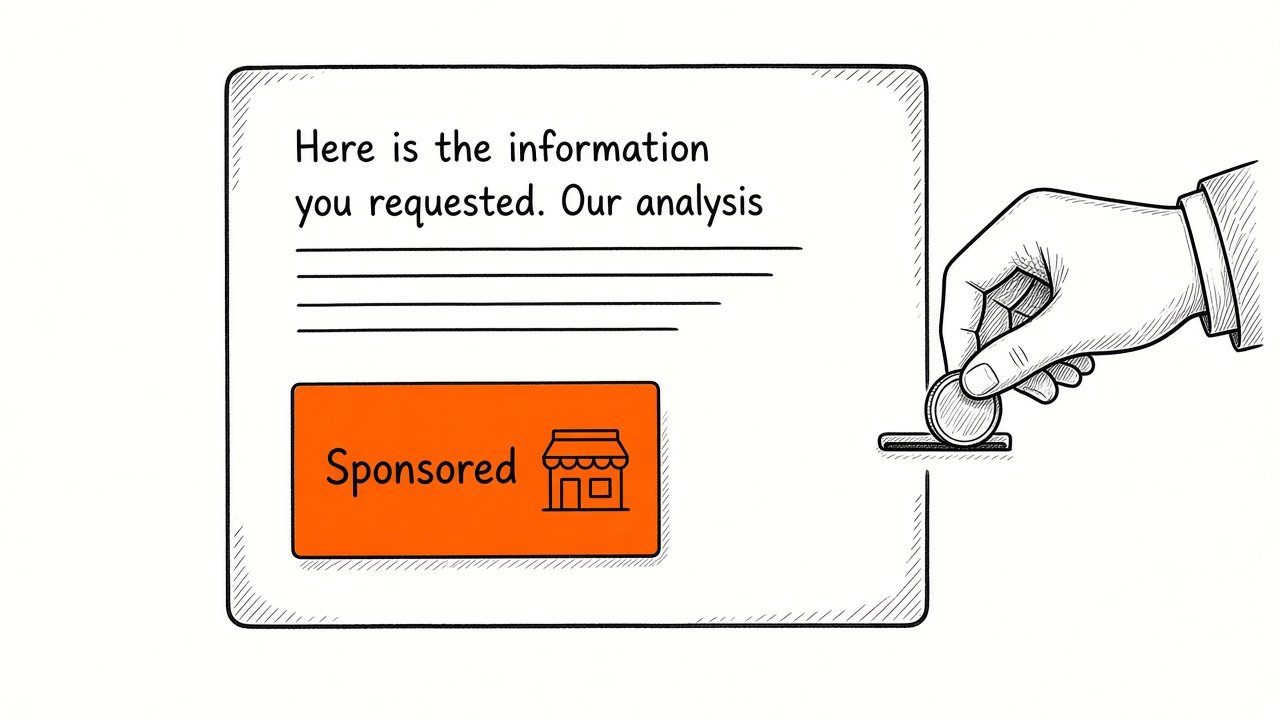
ChatGPT ads are paid placements that appear below a ChatGPT response, clearly labeled and separate from the answer. Each ad shows the advertiser's name, logo, a headline, a description, an image and a link. OpenAI is also testing a multi-image ad that appears while ChatGPT generates an image.
Only some users see them. OpenAI's help page says ads may appear for users on the Free and Go plans. Plus, Pro, Business, Enterprise and Edu accounts don't get ads, and neither do accounts OpenAI identifies as belonging to people under 18. Free users can also switch to an ads-free mode in exchange for lower message limits.
Ads don't appear near sensitive topics such as personal health, mental health or politics, and political ads aren't allowed. Temporary Chats show no ads.
Testing started in the US on 9 February 2026. Self-serve buying through Ads Manager opened in 31 European countries on 31 August 2026, and on 21 October 2026 OpenAI said ChatGPT Ads was live in 89 countries with more than 100,000 advertisers so far.
Do ChatGPT ads influence ChatGPT's answers?
No, according to OpenAI. Its help page says ads "run on separate systems from our chat model, and advertisers have no ability to shape, rank, or alter ChatGPT's responses." The same promise, called answer independence, was in OpenAI's first ads principles in January 2026.
The independent data agrees. SE Ranking recorded every answer, cited source and sponsored placement for 50,006 US commercial prompts in 20 niches. Where an ad appeared, the advertiser's domain was among the answer's cited sources in only 3.63% of placements. The exact advertised URL was cited 12 times, or 0.09%. Even a plain brand mention in the answer showed up in just 4.44% of cases.
Read that the other way round: in 96% of placements, the brand paying for the slot under the answer was not a source for the answer itself.
So two different things happen on the same screen. The answer comes from what ChatGPT finds and trusts, which is the work covered in our guide on how to get your brand recommended by ChatGPT. The ad comes from an auction. Paying for the second doesn't move the first.
How does ChatGPT decide which ad to show?
There are no keywords to bid on. OpenAI says its system picks ads by "expected relevance and outcomes", using the context of the current chat, your ad's title, copy and landing page, your targeting settings and the context hints you write. When ads personalization is on, it can also use signals from the user's past chats and memory.
When several ads qualify, OpenAI runs a relevance-weighted, second-price auction. Relevance and your bid both count.
Context hints do the job keywords do elsewhere, with less control. You add them per ad group as natural phrases about what you offer, who it helps and when it's useful. OpenAI's example: "cushioned everyday running shoes for beginners training for their first 5K" instead of "running shoes". OpenAI is clear that hints "are not exact-match keywords or targeting rules" and guarantee nothing.
Two limits matter for European advertisers. Personalized ads aren't available in the EEA or Switzerland yet, so ads there rely on the current chat only. OpenAI also advises against custom audiences in those countries, and an included audience needs at least 25,000 matched users.
How much do ChatGPT ads cost?
The minimum is set per campaign as a daily budget. OpenAI's minimum campaign spend table, checked on 30 October 2026, lists these amounts:
| Billing currency | Minimum daily budget | About per 30 days |
|---|---|---|
| USD | $25 | $750 |
| EUR | €15 | €450 |
| GBP | £15 | £450 |
| CAD | CA$25 | CA$750 |
| AUD | A$25 | A$750 |
The daily budget is an average over a Sunday to Saturday week. A single day can spend up to twice the amount, but a week never spends more than seven times it. You can set a total campaign budget instead, which OpenAI calls "the stricter control for total spend".
You choose how you pay with the campaign objective:
- Views bills per 1,000 impressions (CPM).
- Clicks bills per valid click (CPC). OpenAI recommends starting with a maximum bid of $3 to $5 per click.
- Conversions optimizes toward an event such as a sign-up but still bills per click (oCPC) or per 1,000 impressions (oCPM). You never pay per conversion.
That $3 to $5 is a starting suggestion, not a market price. OpenAI's own help center says it has no performance benchmarks across advertisers, industries or campaign types yet.
New self-serve accounts have one more catch. Some can advertise only in the country the ad account belongs to, until identity verification is approved and they have spent enough there. Picking other countries doesn't override it.
What CTR and CPC do advertisers actually get?
The best public numbers are collected by others, and they vary widely.
PPC ONE, a Czech PPC agency, gathered every ChatGPT ads result published under a real name (29 September 2026, updated 14 October 2026). Across 24 international campaigns, half had a CTR below 1.25%, with a range from 0.35% to 7.9%. Across 15 campaigns billed in dollars, mostly in the US, CPC ran from $0.76 to $14.80, and half paid less than $4.41. Ten European campaigns paid €0.16 to €2.68 per click.
The spread is the point. The same platform produced $0.76 clicks for one advertiser and $13 clicks for another, so budget for your own test rather than someone else's average.
Panel data shows a gap between markets. A Graphite report on Similarweb panel data, covered by Search Engine Journal on 29 September 2026, measured clicks per ad-bearing reply through mid-September.
The English-speaking markets cluster around 0.7%. Brazil, Mexico, Japan and South Korea sit well above 1%. The report doesn't explain why, and it didn't yet include the European markets.
One test sits right in our own category. SE Ranking ran 48 ads in the US, Canada, Australia and New Zealand aimed at people looking for AI visibility tools, agencies and SEO API users. Over about two weeks it got more than 97,000 impressions and 1,263 clicks, a 1.30% CTR, but "very few sign-ups", and stopped. Its explanation: its ideal customers are heavy AI users who are more likely on ad-free paid plans. That is SE Ranking's reading, not a measurement.
Do ChatGPT ads convert as well as Google Ads?
Not in the tests published so far. PPC ONE found four cases where the same advertiser measured conversion rate on both channels over the same period. Google won all four.
Cheap clicks can hide this. In a StubGroup case study, ChatGPT clicks cost $0.76 against $10.46 on Google, and cost per lead was lower too. But the agency says Google leads became customers "at a significantly higher rate", so Google's cost per customer was still lower.
Paid clicks also seem to behave differently from organic ChatGPT traffic. Software maker Andy Brice saw paid ChatGPT ad clicks convert at 0.46%, against 4.2% for visitors who came from unpaid ChatGPT recommendations. Octolens spent a little over €600 on two weeks of US ads and got no sign-ups from them, while unpaid ChatGPT recommendations brought 10 sign-ups in the same period. Octolens sells AI mention tracking, so treat its conclusion with that in mind.
Most positive comparisons come from agencies that sell ChatGPT ad management. That doesn't make them wrong. It does mean the published sample leans optimistic.
Who should test ChatGPT ads, and how?
Based on the published results, the best fits so far are offers people research step by step in a chat: online stores, consumer software and services that solve one specific problem. Several B2B advertisers with long sales cycles reported no conversions. Ad-free paid plans are one likely reason, though nobody has measured it.
If you test, keep it small and measurable:
- Put UTM tags on every ad URL and check your own analytics, not only Ads Manager. PPC ONE cites one case where reporting showed 36 conversions against 2 real inquiries, and another with zero in the dashboard against three real sales.
- Write several distinct ads and a few specific context hints per ad group. OpenAI recommends "a high volume and diverse set of ads" so the system finds more matching chats.
- Send each ad to the most relevant page, not your homepage, and make sure OAI-AdsBot and OAI-SearchBot can reach it.
- Run at least two weekly budget cycles before judging. Daily results swing a lot.
- Decide on revenue or qualified leads per euro or dollar, not CTR.
Tools are starting to cover the paid side too. Evertune has an Ads Agent that runs and optimizes ChatGPT ads; on its pricing page it costs 10% of media spend on the $60-a-month Starter plan, with the Ads Agent's first 7 days free, and 8% on Pro, which is $800 a month billed annually (checked 30 October 2026). Writesonic includes ads monitoring for ChatGPT and Google AI from its Starter plan at $79 a month billed annually, and Rankscale lists ad analytics on every plan above Essentials (both checked 30 October 2026). Compare all 32 tools on our pricing table.
Should you spend on ads or on getting recommended?
They answer different questions. Ads rent a slot under the answer for as long as you pay. A recommendation is a place in the answer, and it reaches Plus and Business users too, the group that never sees ads.
A sensible order for most marketers and founders:
- Find out where you stand. Ask ChatGPT the questions your buyers ask and note who it names, or run our free AI visibility check. Our guide on mentions, citations and recommendations explains what to count.
- Fix the organic basics: crawler access, plain descriptions of what you sell, and mentions on the pages ChatGPT already cites.
- Test ads only for questions where you can't yet earn a mention, and track your AI share of voice alongside paid results, so you can see whether each one is moving.
FAQs
Do ChatGPT ads affect ChatGPT's answers?
OpenAI says no: ads run on separate systems and advertisers can't shape or rank responses. SE Ranking's July 2026 data fits this, with the advertiser cited in the answer in only 3.63% of ad placements.
How much do ChatGPT ads cost?
The minimum daily budget is $25 for USD accounts and €15 or £15 for EUR and GBP accounts. OpenAI suggests a starting maximum bid of $3 to $5 per click; in published campaigns, half of dollar-billed clicks cost under $4.41.
Who sees ads in ChatGPT?
Users on the Free and Go plans. Plus, Pro, Business, Enterprise and Edu accounts see no ads, and neither do accounts identified as under 18.
Can I target keywords with ChatGPT ads?
No. You write context hints per ad group, which help ChatGPT judge relevance but are not exact-match keywords and guarantee no delivery.
Do ChatGPT ads work for B2B?
The published evidence is weak so far. Several B2B tests, including SE Ranking's own, got clicks but very few sign-ups, and in four same-advertiser tests Google Ads converted better.
Our recommendation
- Don't buy ads to get recommended. They can't put you in the answer. Earn that with the steps in our ChatGPT recommendation guide.
- Test only with money you can afford to lose. A month at the minimum is about $750 or €450.
- Measure with your own analytics and revenue, and stop when the cost per customer is worse than in your proven channels.
- Check the rules again before you start. OpenAI updated most of these help pages in the last week of October 2026, and the product is still in beta.
Sources
- OpenAI Help Center: Ads in ChatGPT (live doc; updated 28 Oct 2026 and checked 30 Oct 2026)
- OpenAI Help Center: Creating campaigns for ChatGPT Ads (live doc; updated 28 Oct 2026 and checked 30 Oct 2026)
- OpenAI Help Center: Daily budgets (live doc; updated 28 Oct 2026 and checked 30 Oct 2026)
- OpenAI Help Center: Creating ads for ChatGPT Ads (live doc; updated 29 Oct 2026 and checked 30 Oct 2026)
- OpenAI Help Center: Ads in ChatGPT the basics (live doc; updated 23 Oct 2026 and checked 30 Oct 2026)
- OpenAI Help Center: Write context hints for ChatGPT Ads (live doc; checked 30 Oct 2026)
- OpenAI: ChatGPT Ads expands to 26 new countries (21 Oct 2026)
- PPC ONE: International ChatGPT Ads results (29 Sep 2026 and updated 14 Oct 2026)
- Search Engine Journal: ChatGPT ad CTR topped 1% in 4 markets not in the US (29 Sep 2026)
- OpenAI: ChatGPT Ads expands across Europe (18 Aug 2026 and updated 31 Aug 2026)
- SE Ranking: ChatGPT shows ads for 1 in 4 commercial prompts (10 Aug 2026)
- Evertune pricing (checked 30 Oct 2026)
- Writesonic pricing (checked 30 Oct 2026)
- Rankscale pricing (checked 30 Oct 2026)
- Background: OpenAI Our approach to advertising and expanding access to ChatGPT (16 Jan 2026)
All prices were checked on each vendor's official pricing page on the date shown. Prices change, so confirm before you buy.
Tools mentioned


See where your brand stands in AI answers
Run the free AI visibility check. It takes a minute and the result comes by email.
Run the free check →Keep reading
Get the free GEO tool pricing sheet + weekly AI visibility tips
Every GEO tool I track on one sheet, each price checked on the vendor's own page.
Plus practical AI visibility tips, new tools and price changes.
One email a week, no spam. Unsubscribe any time.
By subscribing you agree to our Privacy Policy.